


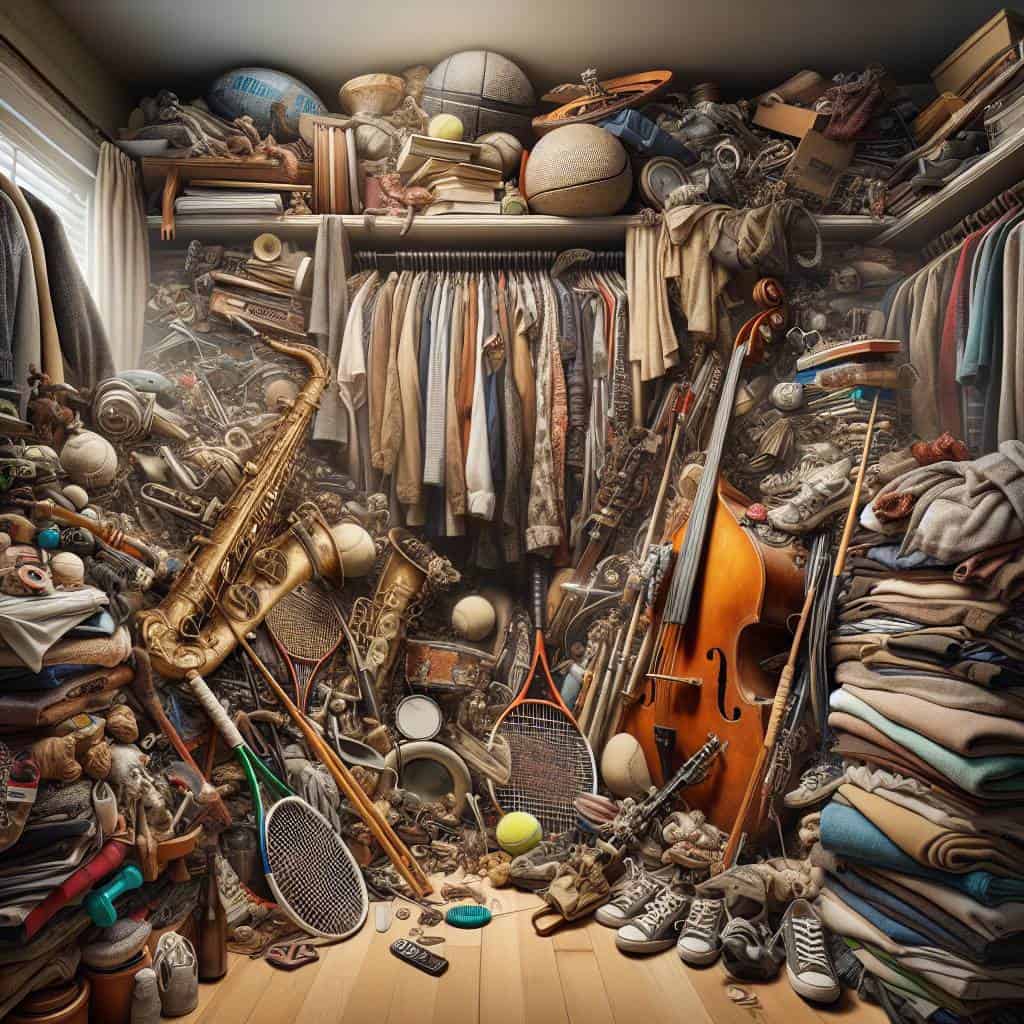
I once opened a closet door and got smacked in the face by a rogue tennis racket. It was a wake-up call, a not-so-gentle reminder that my life was slowly being buried under an avalanche of old hobbies and impulsive purchases. You see, decluttering isn’t just about tidying up; it’s a brutal confrontation with your past decisions. It’s standing toe-to-toe with that dusty saxophone you swore you’d learn but never did, or the mountain of concert tees you can’t bear to part with despite the pit stains. My suburban upbringing taught me one thing: if you don’t deal with your clutter, it deals with you—and usually in the form of a surprise attack.
So, what can you expect here? Well, for starters, I’m not going to throw the word “KonMari” at you like it’s some magical incantation. Instead, I’m going to take you on a journey through the art of decluttering—warts and all. We’ll sift through the piles together, cutting through the BS and getting real about what it means to truly get organized. This isn’t about achieving some Instagram-worthy minimalist utopia. It’s about reclaiming your space and, by extension, a bit of your sanity. Ready to roll up your sleeves? Let’s dive in.
Table of Contents
How the KonMari Method Almost Turned My Home Into a Zen Garden (Spoiler: It Didn’t)
I dived into the KonMari Method with the kind of enthusiasm usually reserved for New Year’s resolutions and gym memberships—naïve and full of hope. Marie Kondo made it sound so simple: hold onto the stuff that sparks joy and kiss the rest goodbye. Easy, right? I pictured my home turning into a serene Zen garden, where every item had a purpose, every corner a breath of fresh air. I started with my closet, a veritable museum of past life stages and questionable fashion choices. Out went the jeans from college that I’d kept as a monument to my slimmer days, and the band tees that screamed “midlife crisis.
But here’s the kicker—my home’s transformation hit a snag. The kitchen, that unsuspecting battlefield, became my Waterloo. The KonMari Method didn’t account for my sentimental attachment to grandma’s chipped china or the bread maker I swore I’d use one day. Each item had a story, a memory, or a “just in case” scenario. My Zen garden dream started to resemble more of a Zen construction zone. Sure, I rid myself of a lot, but it was like playing a never-ending game of Tetris with my belongings; clear one row, and another precariously wobbles into place.
So, spoiler alert: my home didn’t quite morph into the minimalist sanctuary I envisioned. But here’s the thing—maybe it doesn’t have to. The clutter that remains is a reflection of the life I’ve lived, the stories waiting to be told, the imperfect journey I’m on. And maybe that’s okay. Maybe the true art of decluttering isn’t about achieving perfection but about creating a space that’s authentically yours, even if it means making peace with a little chaos.
Chaos Surrendered
Decluttering isn’t just tidying up; it’s an exorcism of the ghosts of your past decisions. Each item gone is a whisper of freedom and a step toward the life you actually want.
The Cluttered Truth We Can’t Ignore
The art of decluttering isn’t some mystical journey to inner peace or a ticket to a life that looks like a Pinterest board. It’s more like a mirror, reflecting the chaos you’ve chosen to live with. When I first attempted the KonMari method, I expected to be enlightened, to transform my home into a zen sanctuary. Spoiler alert: I failed spectacularly. But in that failure, I found something more valuable than a neatly folded sock drawer. I discovered the uncomfortable truth about my relationship with stuff—the emotional baggage stitched into every impulse buy and forgotten souvenir.
Maybe that’s the real magic of decluttering. Not the promise of a minimalist oasis, but the raw, unfiltered confrontation with the parts of ourselves we prefer to ignore. So, here’s the deal: you can follow all the guides and methods in the world, but the only path worth taking is the one that challenges you to face your cluttered truths. Because at the end of the day, it’s not about getting organized; it’s about getting real. And that, my friends, is a journey worth embarking on.